
The idea of a finca stands for calm, nature and independence. In practice, however, building in the countryside demands far more preliminary checks than a project in an urban setting. In suelo rústico in particular, success is decided early: by land status, minimum plot size, protection status, infrastructure and an assessment of existing buildings.
Since 2004 the PTIM of the Consell de Mallorca has set, for residential use in suelo rústico in the relevant constellations, a threshold of 14,000 m² as the minimum size for buildable plots classified as SRG (suelo rústico general). This point belongs almost at the start of any serious advice on building in the countryside. The first filter is this land classification, the next is the protection status (Consell de Mallorca). Then come the criteria to check and resolve: availability of water, wastewater treatment, flood protection, infrastructure and utilities, access, topography and the status of existing buildings (PTM 2004).
At the same time, building in suelo rústico remains strictly regulated despite the reforms. (PTIM)
Since the end of 2024, Decreto Ley 6/2024 has also been relevant. It protects people and property in flood-prone zones. In parallel, Mallorca applied the extraordinary legalisation procedure in suelo rústico first in 2024 and again in 2025 after Ley 7/2024 came into force. (Web GOIB)
In addition, Modification No. 4 of the PTIM (MD4PTIM) is under way; the Plenary of the Consell de Mallorca initially approved it on 10 April 2025 (BOIB No. 47 of 17 April 2025). Its current status should be checked with the Consell before any planning.
On 30 July 2026 the Plenary of the Consell de Mallorca also adopted a resolution (BOIB No. 103/2026) defining which activities and uses are expressly prohibited and therefore excluded from the extraordinary legalisation procedure. Before any application, it must therefore be checked whether the existing use falls under these exclusions.
The PTIM generally regulates only the basic requirements that apply to rural areas outside built-up settlements across Mallorca. In addition, each of the 53 municipalities has its own building regulations, which set different requirements for construction methods, typologies and local building traditions.
A finca near Artà may therefore be subject to different requirements than a finca near Felanitx or Santanyí.
Many buyers equate large plots with building rights. That is a typical mistake. What matters is not only the area but above all the specific land classification (see below) and the location inside or outside protected areas.
In rural areas, nature, landscape, road, coastal, forest or flood regulations can restrict a project considerably or prevent it altogether. Since the Balearic flood decree of December 2024, new houses in certain flood-prone areas of suelo rústico have been restricted further. (Web GOIB)
Water, electricity, wastewater, access and terrain usually have a greater effect on cost and viability in the countryside than in urban areas. A beautiful plot without reliable infrastructure quickly becomes far less attractive than it first appears.
Rural properties have often been altered over many years. Outbuildings, terraces, plant rooms, pools or extensions should never be taken over unchecked. Visible buildings are often only the beginning of the review in the countryside.
Plots with existing buildings also have to be checked precisely. The main house, its extensions, outbuildings, pool, guest house, garages, (covered) terraces, boundary walls, water tanks (aljibes) or infrastructure may exist, may have an officially registered use, and may still have no recorded planning documentation. Existing buildings must be fully recorded, approved and verifiable at the planning offices or, where they are not, be legalisable retroactively.
Before buying a plot with existing buildings, it is therefore not enough to check the title deed, all building files, cadastre entries, building regulations, official requirements and the full chronological register history; the legalisability of the existing buildings must be checked as well.
Plot size(s)
Segregation, divisions, re-parcelling
Use – compliance with the single-family-house criterion
Legality of existing buildings
Building parameters, NNSS
Planning certificate: cédula urbanística, informe previo
Classification in the countryside:
ANEI, AANP, ARIP, APR, APT, SRG, SRG-F, AIA, AT, etc.
Distances
Heights
Volume
Protection status
Slope and gradient of the plot
Municipal and regional topographic and geological particularities
Utilities, infrastructure
Ownership
Area figures in the land register entry, title register, cadastre entry
Not in general. There are procedural changes and legalisation options for certain existing cases, but no blanket approval for new buildings. (Web GOIB)
Because land status, protected areas, water, wastewater, access and existing buildings interact far more strongly here.
No. What matters is the result of a comprehensive check of compliance with the criteria: classification (ANEI, AANP, ARIP, APR, APT, SRG, SRG-F, AIA, AT, etc.), servicing, infrastructure, topography, slope, protection status, geological particularities, ownership, register entries, legacy burdens and existing buildings.
Anyone who wants to build in the countryside should first check the reality of the plot – and only then fulfil the dream.
Suelo rústico is not “free building land”.
It is protected, agricultural, landscape or transitional land. Buildability results from several levels: Balearic law, the PTIM, municipal planning, protection categories, risk zones and sectoral permits.
The first step is always the planning classification of the plot:
PTIM category, municipal plan, risk maps, cadastre, land register, existing use restrictions, rights of way and easements for lines. For this, the Consell de Mallorca provides, among other things, mapping of the “categorías de suelo rústico” and “áreas de prevención de riesgo”. (Planificació Territorial)
Not every large finca can be built on.
Decisive are the minimum plot size, category, history of divisions, existing restrictions, level of protection, topography, access, services and the specific municipal regulations. In the best case, volumes of up to 1,500 m³ are permitted, even if the plot measures 2,000,000 m².
Not every large finca can be built on. Decisive are the minimum plot size, soil and protection category, origin and history of the plot, existing restrictions, topography, access, services and the planning law that actually applies.
Divisions and segregations in suelo rústico are not generally prohibited. They are permitted only if they are compatible with both planning and agricultural legislation, and as a rule they require a municipal licencia urbanística. For older divisions, the date of origin, the legal situation at the time and the agricultural minimum areas must be examined separately.
PTIM
Pla Territorial Insular de Mallorca; the overarching spatial plan of the island of Mallorca.
SRP
Suelo Rústico Protegido; protected rústico.
SRC
Suelo Rústico Común; general rústico.
AANP
Área Natural de Especial Interés de Alto Nivel de Protección; highest protection category.
ANEI
Área Natural de Especial Interés; natural area of special interest.
ARIP
Área Rural de Interés Paisajístico; rural area of special landscape value.
APR
Área de Prevención de Riesgos; risk area, e.g. fire, erosion, flooding, landslide, aquifer.
APT
Área de Protección Territorial; territorially protected area, often in connection with road, coastal or infrastructure protection.
AIA
Área de Interés Agrario; area of particular agricultural relevance.
AT
Área de Transición; transition zone between settlement and rústico.
SRG
Suelo Rústico de Régimen General; general rústico with lower protection intensity than SRP.
SRG-F
Suelo Rústico de Régimen General Forestal; general rústico with forest character.
AAPI
Área de Asentamiento en Paisaje de Interés; settlement area within a landscape of interest, especially in special protection areas such as the Serra de Tramuntana. (BOE)
AATP
not a common standard term of the Balearic matrix. In practice, APT is often meant; sometimes AAPI, AT or a municipal sub-category is also confused with it. The specific planning drawing is decisive.
project examples:
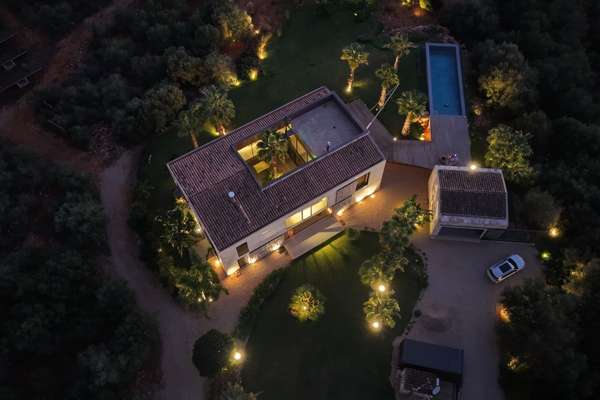
1323 finca son dc, felanitx

1710 finca na borras, cala llombards
or

back to the building in Mallorca guide
References
PTIM Mallorca, Texto consolidado 2023 Consell de Mallorca Entry to the current PTIM system
PTIM 2004, Normas Consell de Mallorca Direct source for the minimum plot of 14,000 m²
Decreto Ley 6/2024 CAIB Flood protection and restrictions
Acuerdo Pleno Mallorca 20.06.2024 BOIB PDF First application in Mallorca of the legalización extraordinaria
Ley 7/2024 with reference to Mallorca 2025 CAIB Second application in Mallorca under the new legal situation